

'I Don’t Need to Tell You Things Are Bad'
Prescient movies and public contempt

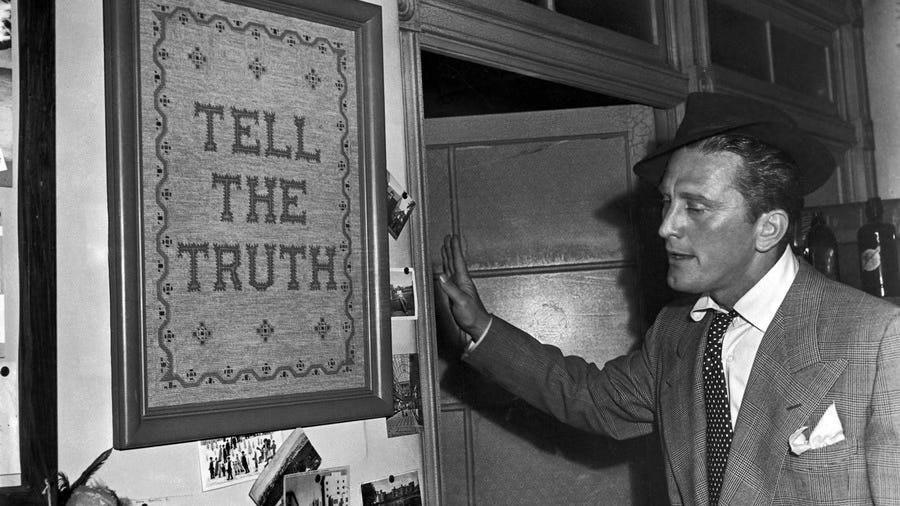
An odd feeling sets in when you’re watching an old movie and the details feel relevant to today. I don’t mean that it addresses the general, timeless themes of life and the human condition; I mean the story speaks specifically about the way we live now. Characters in dated costumes talk as if they’ve been looking over your shoulder as you scroll on your phone.
Recency bias plays into this. We go into a movie with a head full of ideas and anxieties. Sometimes we watch to forget about whatever is on our mind. Other times we need movies to make sense of our uninvited and untamable thoughts; to polish the lens we can never lift.
Still, prescience is striking. When a black-and-white movie describes how you watch Instagram videos, or when a voice from a cloud of Aqua Net outlines a reckless political project that’s still underway, it can bring about a feeling of hopelessness. Nothing changes. We had the diagnosis and we let the illness spread.
In this case, I’m thinking about two movies—Ace in the Hole and Network—that shone the projector’s light on two of our most malignant tendencies, namely our love of the lurid and our willingness to ignore the goals of the whoever feeds that love, to the point that we’re numb to anything except titillation and revulsion. Watching these movies again, I’m not so sure about that metaphor I just used. Maybe they didn’t diagnose a disease, they described our basic biology.
These movies were released a quarter-century apart, the first seventy-five years ago, when the television was more novel than the iPhone is today. They portray the audience’s craving for violence as a social ill and the media’s willingness to provide that violence in an abstracted, easily consumed way as cynical. They make the audience complicit in the most craven acts, up to and including murder. The message can’t be missed, but it can be ignored. And it was. The way we lived then is the way we live now.
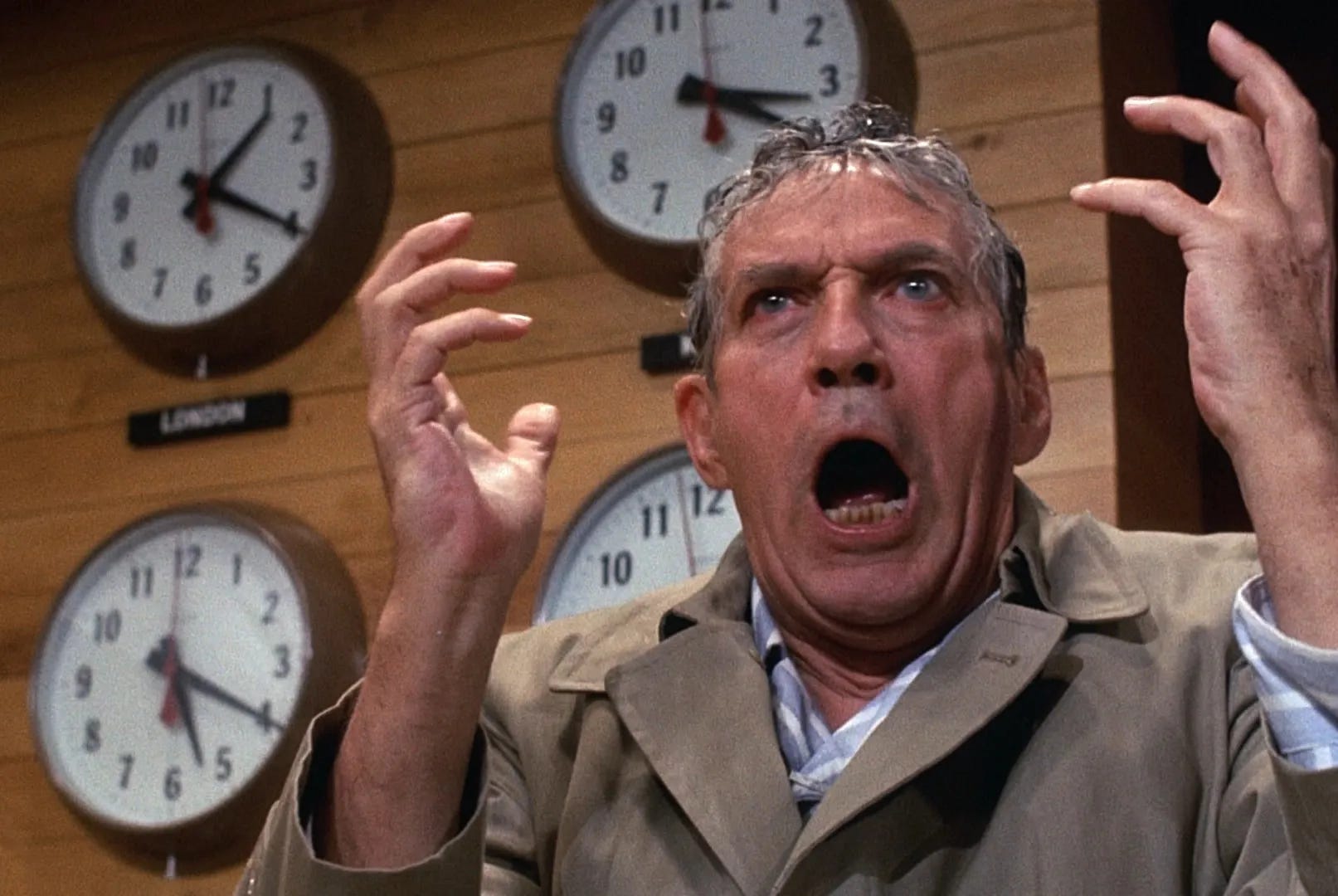
Spoiler alert: I’m going to reveal the endings of the two movies.
Spoiler alert, part two: There’s a tiny bit of hope at the end of this piece.
The world of Billy Wilder’s Ace in the Hole is cluttered with newswire machines, typewriters, and pre-interstate tourist traps. But the happenings of this world are familiar.
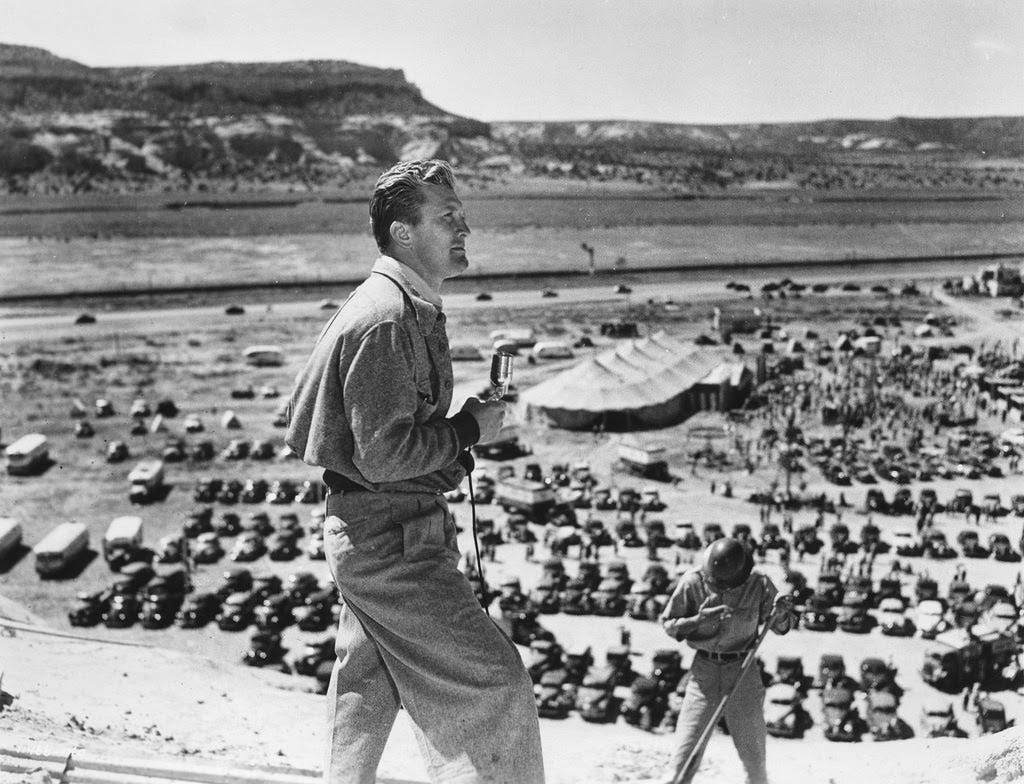
The journalist Charles Tatum, played with arrogant menace by Kirk Douglas, has been chased out of every New York newspaper and is trying to remake his reputation in Albuquerque. When a man taking artifacts from abandoned cliff dwellings is trapped under a fallen rock, he becomes Tatum’s titular ace in the literal hole. Tatum hypes the story. He fudges details to make the man seem more sympathetic, spreads rumors of a curse, and pushes the rescuers to use a slower but more visually dramatic method to get the man out. Soon the desert is full of onlookers—other newspapermen, radio broadcasters, and hundreds of civilians who camp next to their cars.
There’s not much to say about seedy journalists now because there aren’t many actual journalists left—seedy or otherwise. And Tatum isn’t a stand-in for the news writ large (Wilder himself had been a newspaperman before he started making films). Tatum is the sensational side of any media—a side seen still on TV and in text, but now largely reserved for social platforms. He’s after attention and nothing else matters. He’ll do whatever he can to get readers and to keep them excited. He would’ve used memes had they existed at the time. He’d have a subscription offer with exclusive interviews and the paywall popup landing just as the story gets good. Other hustlers would have follow-along podcasts.
Tatum doesn’t give the crowd the truth, he gives them an abstraction of the truth, one where death is real but the person dying isn’t. The trapped man becomes the story of a trapped man; one story among many, with many more to come. “It’s a good story today,” Tatum says. “Tomorrow they’ll wrap a fish in it.”
The public gives Tatum the fame he’s after and asks for more spectacle in return. The rescue scene becomes a media circus and a literal one, with carnival rides for the kids and stands selling snacks. Does the crowd realize what’s at stake? They must; that’s the drama of the situation. But this doesn’t stop their party. Through layers of Tatum’s interpretation, what was once a life-and-death struggle becomes something like the ferris wheel or the hot dog cart—another distraction to enjoy while you can.
In 1976, Sidney Lumet’s Network dropped an office full of Tatums into the world. Faye Dunaway’s Diana Christensen sees the world as a TV show—a drama that follows a predictable narrative, full of stock characters and rattled only by shocking, visceral novelty. Success—of a program, of a life—is measured in ratings. When aging newsman Howard Beale, played by Peter Finch, says he’ll take his life on air, the ratings climb.1 When he begs for a chance to go on the next day and apologize, he again goes off-script and says his earlier outburst was because “I just ran out of bullshit.” He then puts a finer point on it: “Bullshit is all the reasons we give for living.” Beale spent his life in front of the camera, but he’s come to believe he wasn’t informing his audience, he was pacifying them—offering a vision of the world that fit in their living rooms and didn’t bother their day-to-day lives.
The network doesn’t care what Beale says, they care about the reaction he gets—hundreds of thousands of phone calls and millions of viewers. When Beale next goes on the air and tells his audience to open their windows and scream “I’m as mad as hell, and I’m not going to take this anymore,” Christensen smiles from the control room. “We struck the motherlode!” she says. She knows people are mad and she knows it’s more valuable to give them a place to vent than to give them a way to solve their problems.2 As long as people can tune in every night and be angry, it doesn’t matter what they do.
It all unravels when Beale gives his audience a target for their feelings. He tells them to block a buyout of the network’s parent company. This leads the head of the network, Arthur Jensen, played by Ned Beatty, to warn Beale that he has “meddled with the primal forces of nature.”3 That is, he has stopped distracting the audience and instead encouraged them to upset the operations of the corporations that run the world. Jensen continues:
You get up on your little twenty-one inch screen and howl about America and democracy. There is no America. There is no democracy. There is only IBM and ITT and AT&T and DuPont, Dow, Union Carbide, and Exxon. Those are the nations of the world today.
…
We no longer live in a world of nations and ideologies, Mr. Beale. The world is a college of corporations, inexorably determined by the immutable bylaws of business. The world is a business, Mr. Beale. It has been since man crawled out of the slime. And our children will live, Mr. Beale, to see that perfect world in which there’s no war or famine, oppression or brutality -- one vast and ecumenical holding company, for whom all men will work to serve a common profit, in which all men will hold a share of stock, all necessities provided, all anxieties tranquilized, all boredom amused.
Inspired, intimidated, and in the throes of a mental breakdown, Beale focuses his rants on Jensen’s message, telling the audience night after night that the individual doesn’t matter anymore. Ratings tank. People know they’re mad, they don’t want to be told the brutal truth of the world. Christensen and her colleagues arrange to have Beale killed on air so they can get more viewers. The truth is boring. Death gets ratings.
Like with Ace in the Hole, the target of Network’s satire is hardly the powerhouse it once was.4 But also like Ace in the Hole, the precise target is less important than the primary message. The network to worry about today isn’t a news network—it’s a social media network (a remake of Network might be called Platform, but there’s no need to update the film). We all carry around a medium that lets us provoke or be provoked—to make ourselves mad as hell or to shout about it. This is how our boredom is amused.
The most deft users of the platforms aren’t journalists or news networks, as the news business’s continued decline makes clear. The modern Tatums and Christensens are the trolls who build up their numbers and names through truth-bending provocation. The modern Jensens are the tech leaders who make money selling ads against feeds that are full of this provocation, as well as ample distraction and the occasional video that is, essentially, a snuff film.
And this is where I think something is breaking.
Over the last few years, these apps have increasingly offered views to killings—often state killings, police and other law enforcement ending lives; the act captured on camera and presented as Content to scrolling eyes.
As this happened, an odd type of conversation became common. It went something like, “I know there’s a video of a person being killed. I know it’s in the news. But I can’t bring myself to watch it.” This is untenable for a society. A person used to be able to go their entire lives without seeing another human being die. Now it’s hard to go a month without it. And some number of people feel a kind of democratic obligation to witness a person taking another’s life, to replay clips of human beings being shot or choked or otherwise maimed. All of us who are online have had to take a stance on whether we watch these clips or not. The apps that present this video to us take no stand. Views are views. Death gets ratings. And the ratings are even better when some portion of the audience can write off their viewing of snuff films as an activity on par with watching the news.
But just because the images are raw doesn’t mean they can’t be twisted. On one side of this, an industry of right-wing trolls solidified its strength by abstracting the killings until they became stories they could spin and use to their own ends. The story they tell is a false one that explains the killing—justifies it. Their posts spread easily among their followers and easily among their opponents, with screenshots moving messages from platform to platform. Trolling won elections. Provocation is now an official communications strategy. Government departments call people—living and dead—nasty names and repost memes with roots in racist and violent movements of the past. When a killing happens, thousands of people insist the video doesn’t capture what it so clearly captures. A quote from 1984 (“The party told you to reject the evidence of your eyes and ears.”) regularly goes viral. 1984 feels just as prescient as the movies I’ve covered here. Another prescient book, Neil Postman’s Amusing Ourselves to Death, argued that it wasn’t Orwell’s 1984 we were living in, but Huxley’s Brave New World, in which the public welcomes its oppression by unplugging from reality and opting for distracting entertainment.
But on the other side, something else happened. Something more hopeful. For some viewers, the footage was too raw to be abstracted. In the 1990s, Jean Beaudrillard argued that the Gulf War was so made for media, it wasn’t a war at all. The violence online is so clearly real, it can’t be mediated. With each video, even the most privileged or isolated avoiders of information could no longer ignore what they had long heard was happening. There was no need to watch each successive video of murder: Knowing that it not only happened, but happened in plain sight, captured by onlookers, and that it happened over and over with little to no consequence, revealed a truth that overwhelmed any attempt by bad actors to abstract it. The upsetting reality is no foundation for a spun-up narrative. And even the attempts to spin seemed like II transparently callous.
This growing portion of the viewing population got mad. They didn’t stop at Beale’s suggestion to yell about it. They marched. They voted. They called for action. Black Lives Matter protests grew. ICE’s deadly crackdowns in American cities have brought thousands of people to the streets, even more so after more videos of killings spread. Agents killed eight people in the month of January.
There have been shifts before, or bumps in the road of infinite scroll amusement. This time seems different. We’ve been scrolling too long on some big company’s platform to trust them anymore. Seeing the scenes of violence, and then seeing the attempts to spin them, makes it too loud and too clear that there’s a contempt behind it. Tatum and Christensen clearly despise the audience—they think the average person is dumb and just looking for distraction or maybe a little jab to be riled up. You can see it in the trolls today—they have no respect for their fellow human beings. They value others so little, death is only another way to fill up their feeds with commentary. Every event is an attempt to boost their ratings.
As a journalist, I always dreaded meeting a Tatum or working a Christensen. Their contempt and cravenness is off-putting, but what’s demoralizing is the fact that there’s a big business behind it. The network in Network justifies its actions in part by saying it gives the people what they want, but this is revealed to be an excuse; the real justification is that it makes money for the shareholders. Seeing people act like these villains without any motivation beyond attention is even more disturbing. What drives a person with only their phone to spin the news, abstract death, and chase ratings? If this is human nature, then it’s a tendency the social media age has fed and let fester.. Now, I can see signs that the moral rot is like the violence of daily life, and has become too much to ignore. The path away from it is clear. Tune out the trolls. Log off from the platforms.
The sick conflation of clout with power can’t stand under the real weight of serious politics, driven by hundreds of thousands of people marching and hundreds of thousands more using their devices not just to doomscroll, but to donate for supplies and support. Too many lives have been taken. Too many doors burst in with military gear. Too many people are unwilling to be told that individuals don’t matter. They know individuals matter, and they know individuals are stronger when they act together. The distractions that put layers of abstraction and trolling onto real life can’t keep hiding reality. The platforms that once were a soothing soma now reveal what’s been the case all along. The truth isn’t on the screen, it’s in the street.
At the end of Ace in the Hole, the trapped man dies. The drill takes too long to reach him. Tatum doesn’t hold the information to write a story and scoop his competition. He doesn’t try to build it into some kind of narrative to play with the emotions of the gathered crowd. Instead, he goes to the top of the cliff and delivers the news, then gives his last update to the crowd.
“The circus is over.”
Both Finch and Dunaway won acting Oscars for their roles.
At the same time, Christensen is developing The Mao Tse Tung Hour, a weekly show built around a group of militant radicals. It opens with documentary footage of the group’s activities (which we see as robbing banks and kidnapping the rich and famous) then proceeds to tell a story the radicals are free to write. Christensen says she doesn’t care about the politics, she just wants that footage.
Beatty was nominated for an Oscar for this performance.
The most legendary of the old TV networks—CBS—seems intent on making itself even more sclerotic in service of messaging that’s friendlier to the administration. Editor-in-Chief Bari Weiss is sort of an anti-Christensen, more concerned with political messaging than entertainment. She’s refocusing the news on a both-sides-are-valid strategy that amplifies lies and panders to an imaginary heartland audience of real Americans (as a born-and-raised heartlander, I think most of us are sick of being told we’re common folk whose common sense is lacking in Washington). Recently, Weiss announced a slate of new pundits who would be joining the network, effectively watering down the amount of actual news reporting happening in the show and instead giving more time to “debate.” It’s a plan that’s as thin as newly installed evening news anchor Tony Dokoupil’s shirt.
I saw Network many years ago. In the meeting with Mr. Beale, the way Jensen's eyes light up have always indicated a sort of cinematic awakening for the protagonist. When I rewatched it, I wasn't sure if Jensen was smirking in part of it.
When Mr. Beale says "There is only IBM and ITT and AT&T and DuPont, Dow, Union Carbide, and Exxon," obviously these companies existed once before bailouts became the norm for bigger companies, and while their bylaws may be immutable (they're not), his speech seemed to poke fun how even the primal forces aren't invincible. Jensen's idealism could almost be viewed as a rejection of predestination. Or at least as a situational freedom, but that might be getting a bit too philosophical.
That last sentence is *chef's kiss*.